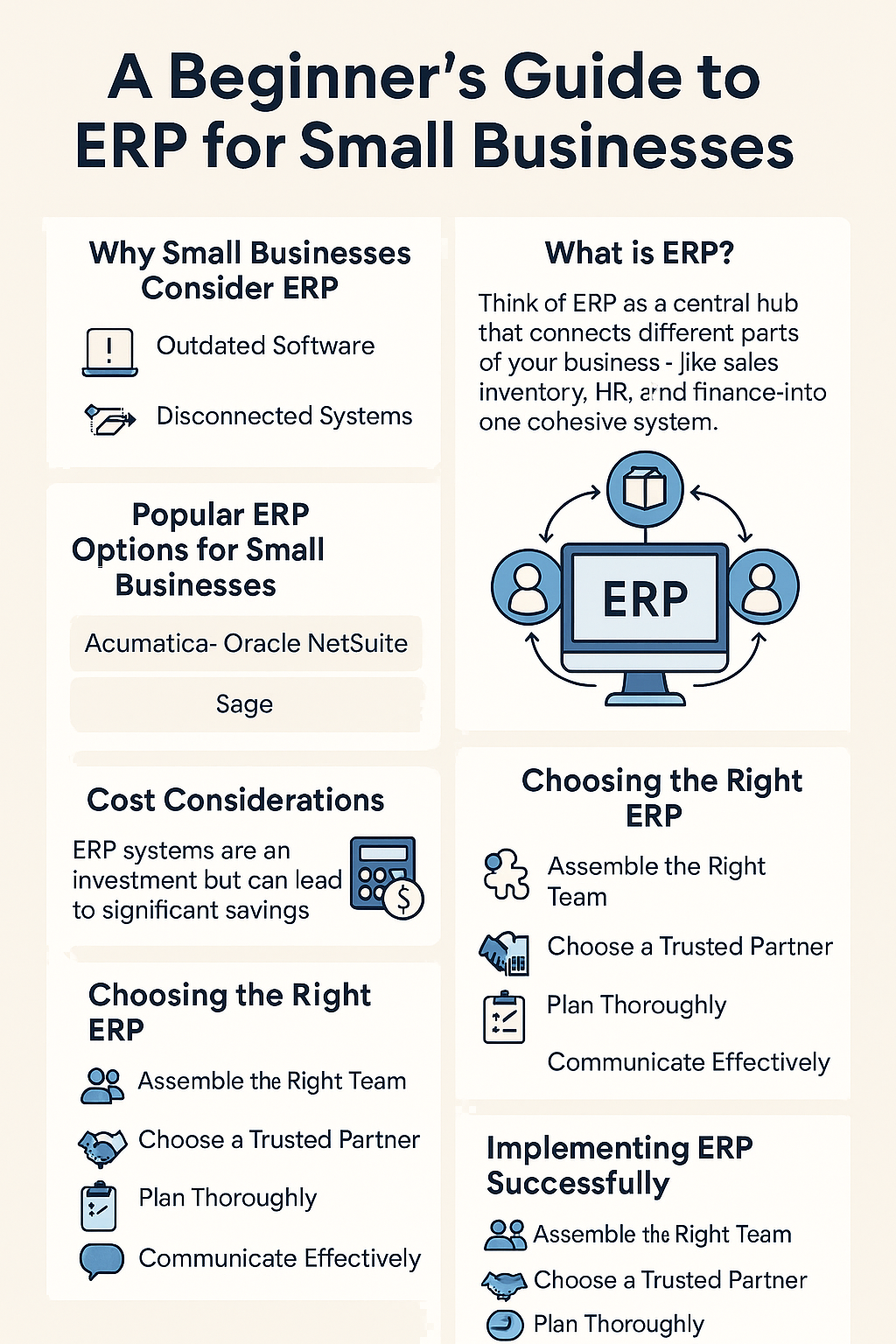
Why Small Businesses Consider ERP
Starting your own business is a big achievement—congratulations! But as your business grows, managing everything from sales and inventory to payroll and customer service can become overwhelming. Often, small businesses face two main tech challenges:
- Outdated Software: Your current tools might not support your growing needs.
- Disconnected Systems: Using multiple programs that don’t communicate well can lead to inefficiencies.
This is where ERP (Enterprise Resource Planning) software comes in. It’s designed to streamline your operations by integrating various business processes into one system.
What is ERP?
Think of ERP as a central hub that connects different parts of your business—like sales, inventory, HR, and finance—into one cohesive system. This integration helps in:
- Reducing Manual Work: Automate repetitive tasks.
- Improving Visibility: Get real-time insights into your business.
- Enhancing Efficiency: Streamline processes and improve productivity.
Popular ERP Options for Small Businesses
Here are some ERP solutions tailored for small businesses:
- Acumatica: A cloud-based ERP suitable for businesses with basic accounting needs and fewer than 10 users.
- Oracle NetSuite: Offers comprehensive features and scalability, making it a long-term solution as your business grows.
- Sage: Provides tools to manage finances and automate administrative tasks, helping you save time.
Cost Considerations
ERP systems are an investment, but they can lead to significant savings in the long run. Factors affecting cost include:
- Number of Users: More users typically mean higher costs.
- Features Needed: Only pay for the modules you need.
- Deployment Method: Cloud-based solutions often have lower upfront costs.
Studies show that small businesses can reduce operating costs by up to 20% with ERP and achieve full ROI within approximately 27 months.
Choosing the Right ERP
When selecting an ERP system, consider:
- Business Fit: Does it meet your specific needs?
- Industry Experience: Is it used in your industry?
- Scalability: Can it grow with your business?
- Support and Training: What kind of assistance is available?
Implementing ERP Successfully
To ensure a smooth ERP implementation:
- Assemble the Right Team: Include members from all departments.
- Choose a Trusted Partner: Work with experienced consultants.
- Plan Thoroughly: Set clear goals and timelines.
- Communicate Effectively: Keep everyone informed throughout the process.
Implementing an ERP system can seem daunting, but with the right approach, it can significantly enhance your business operations. If you have any questions or need further assistance, feel free to ask!
RELATED POSTS
View all